

Windermere Medical Group

Business & Corporate Travel Medical Exams: What Employers and Employees Need to Know

Travel Medical Exams
| Created by: Jesse Mayo, MSN, FNP-C | Medically reviewed by: Jesse Mayo, MSN, FNP-C
corporate travel medical exam

Disclaimer: This article is for educational purposes only and does not replace professional medical advice. If you or someone you love is experiencing a mental health emergency, call 988 (Crisis Lifeline) or 911 immediately.

In today’s globally connected economy, U.S.-based companies are sending employees across borders more than ever, whether for short-term projects, leadership summits, or long-term assignments. While travel logistics often take center stage, one critical component is frequently overlooked: corporate travel medical exams.

These exams are not just a formality; they are a strategic safeguard. They help employers protect their workforce, meet international health requirements, and avoid costly disruptions. For employees, they ensure a safer, more confident travel experience with fewer health risks.

This comprehensive guide breaks down everything employers and employees need to know, from compliance and vaccinations to risk assessments and best practices, while positioning your organization to handle corporate travel health the right way.

What Is a Business Travel Medical Exam?

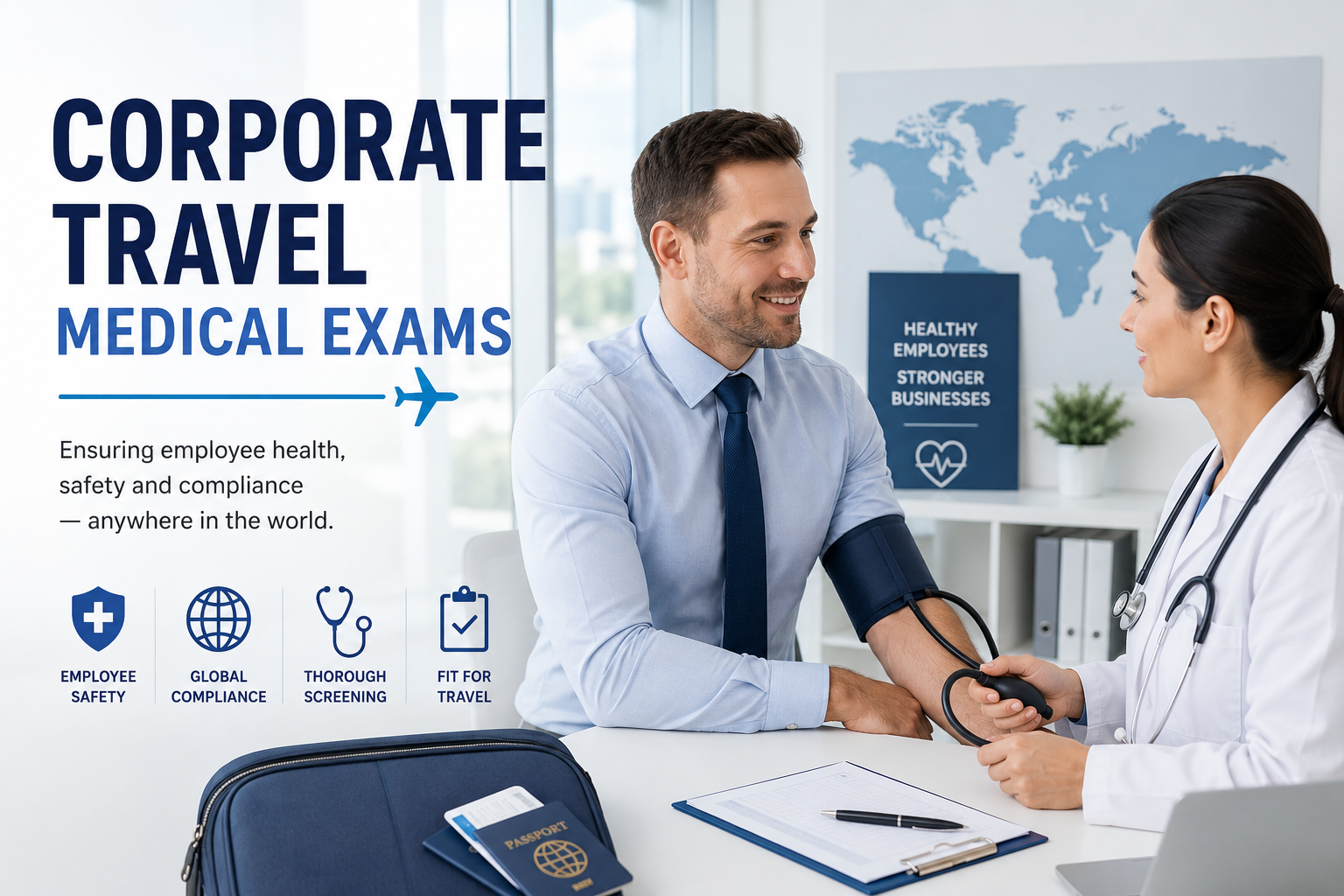
A business travel medical exam is a pre-travel health evaluation designed to assess an individual’s fitness for travel, identify potential risks, and ensure compliance with destination-specific health requirements. Unlike a routine annual physical, these exams are tailored to:
  • The destination country
  • Duration of travel
  • Type of work being performed
  • Individual health history
They often include a combination of:
  • Medical history review
  • Physical examination
  • Required and recommended vaccinations
  • Travel-specific health counseling

Why Corporate Travel Medical Exams Matter

Corporate travel medical exams are essential for maintaining employee health and productivity, fulfilling legal duty of care obligations, and managing risks associated with international or high-risk assignments. These assessments, which often include physicals and vaccinations, are designed to prevent travel-related health problems and ensure employees are fit for their working environment.

For Employers

Corporate travel health programs are not just about employee care; they are also about risk management and compliance.

Key benefits:

  • Reduces liability and legal exposure
  • Ensures compliance with international travel health regulations
  • Minimizes trip disruptions due to illness
  • Enhances employee productivity and readiness
  • Strengthens duty of care obligations

For Employees

From unfamiliar environments to new pathogens, international travel comes with unique health challenges.

Key benefits:

  • Protection against region-specific diseases
  • Guidance on managing chronic conditions while traveling
  • Access to preventive care before departure
  • Increased confidence and peace of mind

Who Needs a Corporate Travel Medical Exam?

Not every trip carries the same risk, but many employees can benefit from a structured pre-travel health evaluation.

Employees Who Should Prioritize Travel Exams:

  • International business travelers
  • Employees on long-term or frequent travel assignments
  • Executives attending global conferences or leadership summits
  • Field workers or engineers traveling to remote or high-risk areas
  • Employees with chronic medical conditions (e.g., asthma, diabetes, heart conditions)
  • Pregnant employees or those with compromised immunity

High-Risk Travel Situations:

  • Travel to regions with infectious disease outbreaks
  • Assignments in areas with limited healthcare access
  • Work in extreme climates or high altitudes

What’s Included in a Corporate Travel Medical Exam?

What’s Included in a Corporate Travel Medical Exam?

Here’s a breakdown of what a typical exam may involve:

1. Comprehensive Health Assessment

  • Review of medical history
  • Current medications and allergies
  • Chronic condition evaluation (e.g., diabetes, hypertension)
  • Physical examination

2. Destination-Specific Risk Evaluation

Healthcare providers assess risks based on:

  • Local disease prevalence
  • Climate and environmental conditions
  • Access to healthcare facilities
  • Length and purpose of stay

3. Vaccinations & Immunizations

Vaccines are a core component of travel health exams.

Common travel vaccines include:

  • Hepatitis A & B
  • Typhoid
  • Yellow fever (required for certain countries)
  • Tetanus boosters
  • Influenza

4. Preventive Medications

Depending on the destination:

  • Malaria prophylaxis
  • Traveler’s diarrhea medications
  • Altitude sickness prevention

5. Travel Health Counseling

Employees receive guidance on:

  • Food and water safety
  • Insect bite prevention
  • Jet lag and fatigue management
  • Emergency medical access abroad

Duty of Care Explained: What Employers Are Legally Responsible For

This is the part of corporate travel health that HR teams and travel managers often underestimate. Employers in the United States have a legal obligation under the OSHA General Duty Clause to protect employees from foreseeable workplace hazards, and that obligation does not end when an employee leaves the U.S. office. Business travel is considered part of work. This includes:
  • Identifying health risks associated with travel
  • Providing access to appropriate medical evaluations
  • Ensuring employees are fit for assigned duties abroad
  • Offering resources for emergency medical care
Failing to address these responsibilities can result in:
  • Legal consequences
  • Insurance complications
  • Reputational damage
The framework covers risk assessment, mitigation planning, traveler communication, emergency response, and post-travel review. A corporate travel medical exam is one of the most direct and documentable ways a company can demonstrate it took the standard of care seriously.

The Doctor-Approved Pre-Travel Checklist for Business Travelers

Business travel moves fast, and the health preparation conversation almost always gets pushed to the last few days before departure. This checklist is designed to prevent that. Work through it from the top as soon as your travel dates are confirmed, not the week before your flight.  
When What to Do Why It Matters
As soon as travel is confirmed Book your pre-travel medical consultation at Windermere Medical Group Vaccines require time to build immunity; some series take weeks to complete
6+ weeks before departure Pull together your vaccination records and current medication list Your physician needs your full immunization history to identify gaps accurately
At your medical appointment Receive all destination-specific vaccines in-clinic; get ICVP issued if your destination requires yellow fever proof ICVP must be issued at an authorized center and is valid no earlier than 10 days after vaccination
At your medical appointment Discuss and fill antimalarial prophylaxis, altitude medication, or standby diarrhea antibiotics as indicated These cannot be prescribed or filled after arrival; your window closes at departure
At your medical appointment Request a written medical summary if you have any chronic conditions, take prescription medications, or carry medical devices Foreign emergency providers need this to treat you correctly; without it they are starting from zero
2 to 3 weeks before departure Confirm you have a full medication supply plus at least 10 extra days for delays Prescription refills abroad can be impossible, counterfeit, or criminally controlled in certain countries
2 to 3 weeks before departure Check your destination country’s customs rules on your specific medications Some controlled substances and even common medications are illegal to import into certain countries
1 week before departure Research the nearest credible medical facility to each stop on your itinerary Knowing where to go before you need it eliminates dangerous delays in an actual emergency
Before you leave Confirm your travel insurance covers emergency medical care and medical evacuation Standard corporate travel insurance often excludes or caps medical costs in ways that create major gaps
Before you leave Share your itinerary, physician contact, and emergency plan with a colleague or family member at home Someone at home needs to know where you are and how to reach your doctor if you cannot communicate
Day of departure Move all medications, medical documents, ICVP, and written medical summary to carry-on luggage only Checked bags are lost. Medical supplies in checked luggage are inaccessible if separated from you
During travel Take antimalarial prophylaxis and other preventive medications on the prescribed schedule, even when feeling well These medications only work when taken consistently; skipping doses while traveling is the leading cause of preventable malaria in business travelers
On return If you develop fever, diarrhea, rash, or unexplained fatigue within 3 weeks of returning, call your physician and mention your travel itinerary immediately Post-travel illness is frequently missed or misdiagnosed when providers do not know about recent international travel
  Need help working through this checklist before your next trip? Windermere Medical Group’s corporate travel appointments are available at all six Georgia locations: book online or call (678) 455-2800.

When Should a Travel Medical Exam Be Scheduled?

Timing is crucial for effective preparation.

Travel TimelineRecommended Action
6-8 weeks before travelSchedule a medical exam
4-6 weeks before travelComplete vaccinations
1-2 weeks before travelFinal health clearance & documentation

Why early planning matters:

  • Some vaccines require multiple doses
  • Immunity takes time to develop
  • Medical conditions may need stabilization

Trusted Medical Care, Wherever You Are

With established offices in:

and convenient Same Day Clinic and Virtual Clinic options. Our providers deliver ongoing medical care for children, adults, and seniors, including preventive visits, annual physical exams, chronic disease management, Medicare-supported visits, psychiatric services, and more. We are committed to accessible, relationship-based healthcare and are currently accepting new patients across all locations. Looking for a trusted medical provider near you? Schedule your appointment today and experience care designed around your needs, in person or online.
Trusted Medical

Common Health Risks for Business Travelers

Understanding risks allows both employers and employees to prepare effectively.

Infectious Diseases

  • Malaria
  • Dengue fever
  • Hepatitis
  • Tuberculosis

Environmental Risks

  • Extreme heat or cold
  • Air pollution
  • Altitude sickness

Lifestyle & Travel-Related Risks

  • Jet lag and fatigue
  • Poor diet or hydration
  • Stress and burnout

Corporate Travel Health Programs

Leading organizations are now implementing structured corporate travel health programs instead of handling travel health on a case-by-case basis.

What These Programs Include:

  • Pre-travel medical exams
  • Vaccination tracking systems
  • Digital health records access
  • Emergency support services
  • Post-travel health monitoring

Why They Work:

  • Standardizes processes across teams
  • Improves compliance
  • Enhances employee safety and satisfaction

Pre-Travel vs. Post-Travel Medical Care

A strong travel health strategy doesn’t end when the trip begins.

Pre-Travel Focus:

  • Prevention
  • Risk identification
  • Immunizations

Post-Travel Focus:

  • Screening for infections
  • Monitoring symptoms
  • Addressing travel-related illnesses

Pre-Travel vs. Post-Travel Medical Care

A strong travel health strategy doesn’t end when the trip begins.

Pre-Travel Focus:

  • Prevention
  • Risk identification
  • Immunizations

Post-Travel Focus:

  • Screening for infections
  • Monitoring symptoms
  • Addressing travel-related illnesses

When Should a Travel Medical Exam Be Scheduled?

TimelineAction
6-8 weeks before travelBook exam
4-6 weeksComplete vaccines
1-2 weeksFinal clearance

Early planning ensures full protection and avoids last-minute complications.

How to Choose the Right Travel Health Provider

Not all healthcare providers specialize in travel medicine. Choosing the right partner is critical for both accuracy and compliance.

Look for Providers That Offer:

  • Expertise in travel medicine and occupational health
  • Up-to-date knowledge of CDC and WHO guidelines
  • Customized travel risk assessments
  • On-site or corporate health program capabilities
  • Digital documentation and reporting

A specialized provider ensures your organization isn’t just checking a box, but actually protecting its workforce.

Documentation & Compliance Requirements

Many countries require proof of vaccinations or health clearance.

Common Documentation Includes:

  • International Certificate of Vaccination (Yellow Card)
  • Medical clearance forms
  • Prescription documentation for medications

Failing to carry proper documentation can result in:

  • Denied entry
  • Quarantine requirements
  • Travel delays

A Practical Pre-Travel Checklist for Business Travelers

While medical readiness is key, practical preparation is equally important.

Health & Safety Prep:

  • Research nearby hospitals and clinics
  • Save emergency contact numbers
  • Download digital health records if available

Travel Essentials:

  • Pack hand sanitizers and disinfectants
  • Carry extra prescription medication
  • Stay hydrated during long flights

Work & Wellness Balance:

  • Plan for rest to manage jet lag
  • Avoid over-scheduling meetings on arrival
  • Maintain a healthy sleep routine

This combination of medical and practical readiness ensures a smoother, safer travel experience.

The Future of Corporate Travel Health

As global mobility increases, corporate travel health is evolving rapidly.

Emerging trends include:

  • Telehealth support for traveling employees
  • AI-driven risk assessments
  • Integrated wellness and travel programs
  • Real-time global health alerts

Corporate and Group Travel Medicine at Windermere Medical Group

When it comes to corporate travel health, having the right medical partner makes all the difference.

Windermere Medical Group offers comprehensive corporate and group travel medicine services designed specifically for U.S.-based organizations and professionals traveling globally.

What Sets Them Apart:

  • Customized pre-travel medical exams tailored to destination and role
  • Up-to-date vaccination protocols aligned with global guidelines
  • Expert travel health counseling for individuals and teams
  • Efficient scheduling for corporate groups and large teams
  • Ongoing support for both pre- and post-travel care
Whether you’re sending one executive abroad or managing an entire traveling workforce, their approach ensures compliance, safety, and peace of mind at every stage of the journey.

Final Thoughts

Business travel is an opportunity, but it also comes with responsibility. Corporate travel medical exams are no longer optional; they are a critical component of modern workforce management.

For U.S.-based employers, investing in structured travel health programs means:

  • Reduced risk
  • Improved compliance
  • Healthier, more confident employees

For employees, it means traveling smarter, safer, and more prepared. When done right, corporate travel health isn’t just a requirement; it’s a competitive advantage.

FAQs:

Not always, but they are strongly recommended, especially for international travel or high-risk destinations. Some countries do require specific vaccinations for entry.

Most exams can be completed within 30-60 minutes, though vaccination schedules may extend over several weeks.

Coverage varies. Some employer-sponsored health plans include travel medicine services, but others may not.

Travel exams are especially important in these cases. Providers will assess stability and provide guidance on managing the condition abroad.

Yes, particularly if they visited high-risk areas or experienced symptoms after travel. Post-travel screening helps detect issues early.

About the Author

priya-bayyapureddy-md

Priya Bayyapureddy

Dr. Priya Bayyapureddy, MD is a board certified Internal Medicine doctor with over 20 years of experience in primary care Internal Medicine. Dr. Bayyapureddy completed her Internal Medicine residency at Emory University School of Medicine and internship at University of Tennessee College of Medicine at Chattanooga.