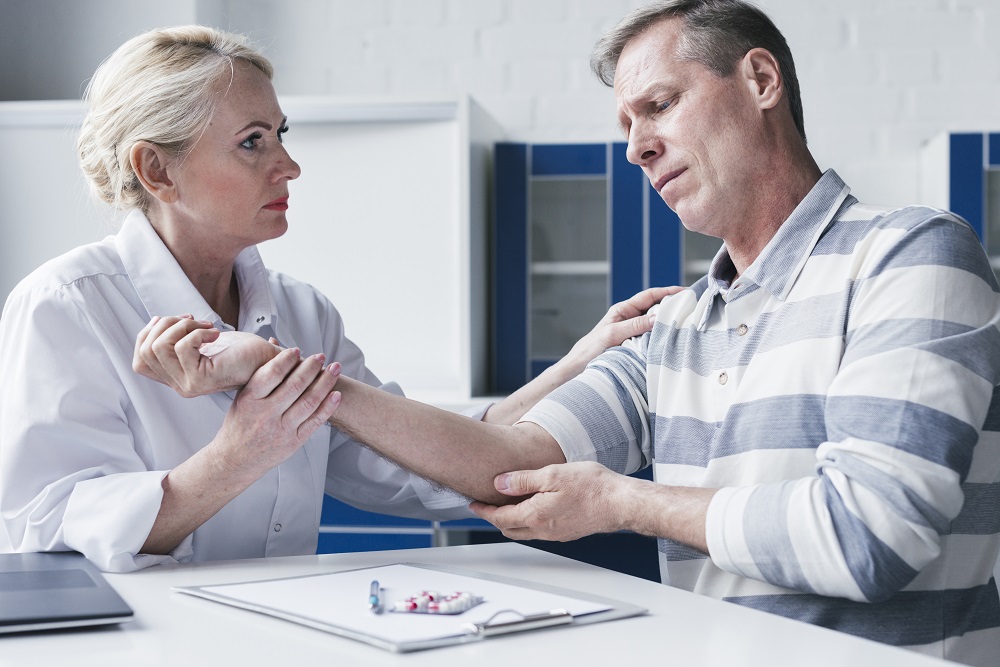

Joint pain is common as you age. But common doesn’t mean inevitable, and it doesn’t mean there’s nothing to be done. For too many older adults across North Georgia, in Cumming, Alpharetta, Canton, and Gainesville, the default response to joint pain is to do less. Walk less. Stop the morning exercise class. Quit the hiking group. Sit more.
That instinct is understandable. It’s also, in most cases, the wrong call.
Appropriate physical activity is one of the most effective treatments for joint pain available to seniors. Not surgery. Not medication. Movement. And when movement alone isn’t enough, there are meaningful non-surgical options that help. This piece covers it all: what’s normal, what’s not, what actually works, and when it’s time to get evaluated.
Joint pain doesn’t have to mean giving up the activities you love. Our primary care sports medicine team at Windermere Medical Group helps seniors across North Georgia stay active, manage pain, and protect their joint health, without jumping straight to surgery. As part of sports medicine and musculoskeletal care, joint health for active older adults is one of the most important areas we work in.
Some joint changes are part of normal aging. Stiffness that eases after you get moving in the morning, the occasional ache after a long day on your feet, these are real, and they’re common. They don’t necessarily mean something is wrong.
But persistent pain that limits daily activities, swelling that doesn’t resolve, or stiffness that gets worse rather than better, that’s not just aging. That’s a medical condition called osteoarthritis, and it responds to treatment.
The distinction matters because one of the most common reasons older adults delay getting help is the belief that joint pain is just something to accept. It isn’t. And the earlier it’s addressed, the more options are on the table.
Osteoarthritis (OA) is a progressive condition in which the cartilage that cushions the ends of bones within a joint gradually breaks down. As cartilage thins and the joint space narrows, bones move with less cushioning, friction increases, and inflammation causes pain and stiffness. It most commonly affects the knees, hips, hands, and spine, and it’s the leading cause of disability in the United States, affecting more than 32 million adults.
OA is not the same as rheumatoid arthritis (RA), which is an autoimmune condition. OA is degenerative, driven by mechanical wear, aging, prior injury, genetics, and body weight.
| Aspect | Normal Joint Aging | Osteoarthritis |
| What’s happening | Gradual, mild changes in cartilage and joint fluid | Progressive cartilage breakdown and joint space narrowing |
| Typical symptoms | Mild stiffness that eases with movement, occasional minor aches | Persistent pain, significant stiffness, swelling, reduced range of motion |
| Effect on daily activity | Minimal ( function largely preserved) | Can significantly limit walking, stairs, and daily tasks |
| Pattern | Symmetric, mild, improves with movement | Often worsens with prolonged activity; may be worse in the morning |
| Response to treatment | Not typically needed (general activity helps) | Responds to PT, injections, medications, and activity modification |
| When to see a doctor | When pain limits daily activity or doesn’t improve | Promptly (early treatment improves outcomes) |
As per the Centers for Disease Control and Prevention (CDC) updated physical activity guidelines for adults 65 and older, state clearly that physical activity is safe and beneficial for people with arthritis and other chronic conditions. Regular movement can help manage arthritis symptoms, reduce joint pain, improve function, and lower the risk of disability over time.
The fear most older adults have, that exercise will wear the joint out faster or make pain worse runs counter to what the evidence shows. What wears joints down faster is inactivity. Cartilage receives nutrients through movement-driven fluid exchange in the joint. Without regular movement, that exchange slows. Muscle strength around the joint decreases. Stability suffers. Pain increases.
If you’re not sure where to start or whether your joint pain needs evaluation before you begin exercising, our team is here to help you figure that out safely.
These are the exercise types with the strongest evidence and the lowest risk of injury for older adults managing joint pain.
Walking is the most accessible joint-friendly activity, and one of the most effective. It strengthens the muscles around the knee and hip, supports cardiovascular health, maintains bone density, and is adjustable to any fitness level.
Is walking good for knee pain in seniors? For most people with mild-to-moderate knee OA, yes. Research consistently shows that walking reduces OA pain and improves function over time. Start with short, flat routes. Supportive footwear matters. A short walking stick or trekking poles can reduce knee load by distributing some weight to the upper body.
Aquatic exercise is particularly well-suited to seniors with significant joint pain. Water’s buoyancy dramatically reduces joint load, allowing movement that may be painful on land to become manageable and even comfortable. Water resistance also builds muscle without impact.
Strength training often surprises older adults, both in how manageable it is and how much it helps. Per ACSM guidelines, adults 65 and older should include muscle-strengthening activity at least two days per week.
Stronger quadriceps and hip abductors reduce the load on the knee joint. Stronger hip and core muscles protect the lumbar spine and hip joint. These aren’t abstract benefits; they translate directly into less pain with daily activities and a lower risk of falling. Resistance bands, bodyweight exercises, and light free weights all count. The key is progressive load, starting light and adding gradually as strength builds.
The National Institute on Aging (NIA) highlights tai chi as one of the most well-evidenced exercises for older adults, specifically because it addresses balance, coordination, and fall prevention simultaneously. Regular tai chi practice reduces fall risk, improves proprioception (the body’s sense of joint position), and has specific evidence for reducing OA pain in the knee and hip.
Balance activities should be done at least two to three times per week, per ACSM guidelines. Standing on one foot, heel-to-toe walking, and side steps are simple starting points.
Regular flexibility work reduces morning stiffness, supports joint range of motion, and improves the general ease of daily movement. Gentle yoga, chair-based or mat-based, at a level appropriate for the individual, has good evidence for both physical and psychological benefits in older adults with arthritis.
Exercise is the foundation. But it doesn’t always manage joint pain completely, particularly once osteoarthritis reaches a moderate stage. The Arthritis Foundation and AAOS both support a layered approach to OA management that includes several non-surgical options.
Physical therapy (PT) for seniors isn’t generic exercise. A PT assesses which specific muscles are weak or imbalanced, which movement patterns are contributing to joint stress, and what the individual patient can realistically do given their fitness level and other health conditions.
A good PT program for knee OA, for example, targets the quadriceps, hip abductors, and calf muscles specifically, and teaches patients how to maintain those gains independently over time.
Two injection types play a meaningful role in non-surgical joint pain management for older adults:
Corticosteroid (cortisone) injections reduce inflammation quickly and are particularly useful for acute flare-ups of OA or bursitis. Relief often comes within days and lasts 4-8 weeks. They’re generally safe but are typically limited to a few per year in any single joint due to long-term effects on cartilage with repeated use.
Hyaluronic acid (gel) injections viscosupplementation, are FDA-approved for knee osteoarthritis and restore some of the joint’s natural lubrication. Relief typically builds over 2-4 weeks and can last several months. For a full breakdown of what to expect from this option, see gel injections for knee pain.
Knee braces, canes, walkers, and orthotics aren’t signs of giving up; they’re tools that reduce joint load, improve stability, and allow seniors to stay active safely. A cane used in the hand opposite the painful knee, for example, can reduce force across that joint by a meaningful percentage with each step.
The resistance many older adults feel toward assistive devices is understandable. But reframing them as tools that protect independence, not signal its loss, changes the calculation.
Each additional pound of body weight applies roughly four pounds of force across the knee joint with each step. This math works in both directions; even modest weight reduction produces meaningful decreases in knee joint load and OA symptoms.
Staying active doesn’t mean doing everything the same way you did at 40. It means adjusting activities to protect joints while keeping you engaged in the things that matter. Golf with a cart. Gardening in shorter sessions with kneeling pads. Hiking on flatter, well-maintained trails instead of technical terrain.
Pacing strategies, alternating activity and rest, avoiding prolonged repetitive joint stress in a single session, prevent post-activity flares and allow more total activity over time than pushing through pain does.
Falls are the leading cause of injury-related death in adults 65 and older. Per the CDC’s STEADI (Stopping Elderly Accidents, Deaths, and Injuries) program, one in four adults 65 and older falls each year in the U.S. The consequences, hip fractures, head injuries, loss of confidence, and reduced activity, can be severe and cascading.
Here’s what many older adults don’t know: Sedentary behavior increases fall risk by allowing strength, balance, and coordination to decline. Staying active, doing the exercises above, builds the very capacities that prevent falls. The American Geriatrics Society (AGS) clinical practice guidelines on fall prevention specifically identify exercise as the single most effective fall prevention strategy for community-dwelling older adults.
For older adults across North Georgia, Windermere Medical Group provides primary care-based evaluation and management of joint pain, osteoarthritis, and musculoskeletal conditions across six locations.
Joint care for seniors doesn’t happen in isolation. A primary care physician who knows your full health history, your medications, your cardiovascular status, and your other chronic conditions recommends joint treatments that fit your whole picture safely. That context matters enormously.
NSAIDs that are appropriate for a 45-year-old may carry a higher cardiovascular or renal risk in someone older. Injection choices, physical therapy goals, and activity recommendations all need to account for the full patient, not just the painful joint.
That’s the advantage of primary care sports medicine over a specialist-only approach: continuity, context, and coordination.
Joint pain that limits daily function doesn’t always allow for a three-week wait. Same day appointments are available at most Windermere Medical Group locations, making it practical to get evaluated when something changes, rather than waiting until the situation is significantly worse.
Being told to just “accept” joint pain as part of getting older is one of the most frustrating things a patient can hear, especially when you can see what happens to mobility, independence, and quality of life when people stop moving.
You don’t have to accept it. The activities that matter to you, walking the trails at Sawnee Mountain Preserve, keeping up with grandchildren, tending a garden, and playing a round of golf, are worth fighting for. The combination of appropriate exercise, evidence-based treatment, and a primary care team that knows you is what makes staying active in your 60s, 70s, and beyond not just possible but realistic.
Windermere Medical Group serves seniors and active older adults across Cumming, Canton, Gainesville, Baldwin, Alpharetta, and Lawrenceville. Same-day appointments are available at most locations.
Yes, and it’s recommended. Appropriate exercise reduces joint pain, improves function, and lowers the risk of falls. The key is to start at the right level and choose low-impact activities.
No. Appropriate, low-impact exercise does not accelerate OA progression, whereas inactivity worsens outcomes by causing muscle loss and reducing joint stability. The evidence consistently shows that active older adults with OA have better function and less pain than sedentary ones.
Normal aging produces mild stiffness that eases with movement and minimal functional limitation. Osteoarthritis produces persistent pain, significant stiffness, possible swelling, and functional limitations that don’t resolve with gentle movement. OA is a medical condition that responds to treatment.
Walking, swimming, water aerobics, stationary cycling, tai chi, gentle yoga, and light resistance training are the most evidence-supported options. Each builds strength and maintains mobility without high joint impact.
Physical therapy, corticosteroid injections, hyaluronic acid (gel) injections, PRP injections, assistive devices, weight management, and structured activity modification. A primary care provider helps determine which combination fits the individual patient’s condition and goals.
Both are used regularly in older adults. Cortisone injections are appropriate for acute flare-ups, and gel injections are FDA-approved for knee OA and provide longer-lasting relief in appropriate candidates. Your provider evaluates which is more suitable based on your specific situation.
PT addresses the specific strength deficits, movement patterns, and muscle imbalances that contribute to joint pain, not just the pain itself. A targeted PT program for knee OA, for example, reduces joint load by strengthening the muscles that support and stabilize it.
When pain limits daily function, doesn’t improve after 2 weeks of appropriate self-care, disrupts sleep, involves swelling, or requires daily over-the-counter pain relievers to manage. Earlier evaluation means more options and better outcomes.

Dr. Priya Bayyapureddy, MD is a board certified Internal Medicine doctor with over 20 years of experience in primary care Internal Medicine. Dr. Bayyapureddy completed her Internal Medicine residency at Emory University School of Medicine and internship at University of Tennessee College of Medicine at Chattanooga.

Recent Post